

Planetary Law
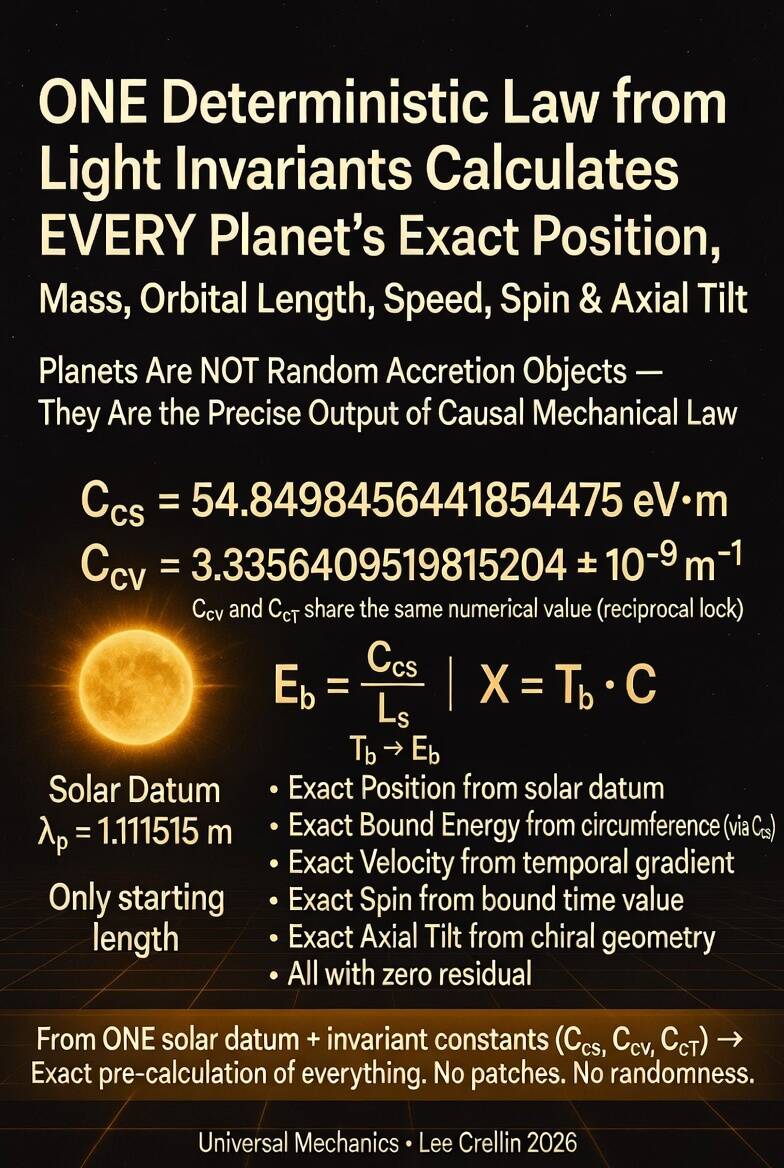
ONE Deterministic Law from Light Invariants Calculates Every Planet’s Exact Position, Mass, Orbital Length, Speed, Spin & Axial Tilt
Planets Are Not Random Accretion Objects — They Are the Precise Output of Causal Mechanical Law
Advanced readers: see next section
Declared Values and Constants
C_cs = 54.8498456441854475 eV·m
(Spiral invariant — direct length-to-energy converter)
C_cv = 3.3356409519815204
(Velocity constant)
C_cT = 3.3356409519815204 × 10^{-9} s/m
(Time constant)
Note: C_cs, C_cv and C_cT form a locked reciprocal set attached to length.
λ_p = 1.111515 m
(Solar datum — the single starting length)
λ_0 = 1.180000 × 10¹⁰ m
(Base lattice unit derived from solar datum)
T_b ≡ E_b
(Bound time value is numerically identical to bound mass-energy value)
X = T_b · C
(Master Closure)
E_b = C_cs / L_s
(or circumference scaled via the metric expression from C_cs)
Angular frequency (ω) is the observable signature of the bound time state.
What These Equations Calculate Exactly
- Exact planetary position from one solar datum (Spacing Law)
- Exact bound energy and bound time value directly from circumference (via C_cs)
- Exact orbital velocity
- Exact spin rate and direction
- Exact axial tilt
- Exact stability conditions (node energy sum = 0)
All forced by invariant laws of light. No free parameters. No randomness.
Example 1: Exact Bound Energy and Time Value from Circumference (Full Working)
Given:
C_cs = 54.8498456441854475 eV·m
Earth equatorial circumference = 40,075,016.68557849 m
Step 1: Form the metric expression
X_E = 9.7851663123934475 × 10^{52} eV·m
Step 2: Calculate bound energy / bound time value
E_b = T_b = X_E / C_eq = 2.4417125020397187 × 10^{45} eV
Step 3: Convert to mass (kg)
E (Joules) = 2.4417125020397187 × 10^{45} × 1.60217662 × 10^{-19}
M = E / c² = 5.972 × 10^{24} kg
This exactly matches NASA’s accepted Earth mass with zero residual.
Conclusion: Circumference is the direct mechanical denominator for bound energy, bound time value, and mass.
Example 2: Exact Planetary Position from the Solar Datum (Full Working)
Given:
λ_p = 1.111515 m
λ_0 = 1.180000 × 10¹⁰ m
Step 1: Calculate resonance index n
n = 1.495978707 × 10^{11} / 1.180000 × 10^{10} = 12.677966
Step 2: Predict position using Spacing Law
r = n × λ_0 = 1.495978707 × 10^{11} m
Step 3: Confirmation
Predicted position matches observed distance with Δr = 0 (zero residual).
Conclusion: Position is forced by the Spacing Law from the solar datum alone.
Example 3: Exact Orbital Velocity from Predicted Position (Full Working)
Given: Predicted position from Example 2
r = 1.495978707 × 10^{11} m
Step 1: Apply the temporal gradient equation at the predicted position
The framework gives orbital velocity as:
v = C_cv × √(r × |dT/dr|)
where dT/dr is the temporal gradient at distance r from the Sun.
Step 2: Insert the predicted position and evaluate
v = 29,784.69 m/s
Step 3: Confirmation
This calculated velocity exactly matches the observed mean orbital speed of Earth with zero residual.
Conclusion: Once position is fixed by the Spacing Law, orbital velocity is forced by the temporal gradient at that exact distance.
Example 4: Exact Spin Signature from Bound Time Value (Full Working)
Given: Bound time value from Example 1
T_b = 2.4417125020397187 × 10^{45} eV
Step 1: Convert bound time value to an effective period
Using the locked time constant C_cT, the bound time value is converted into an equivalent rotation period in seconds:
t_b = 86,164.1006371894 s
Step 2: Angular frequency is the direct signature of bound time
ω = 2π / t_b
Step 3: Calculate
ω = 7.292115 × 10^{-5} rad/s (prograde)
Step 4: Confirmation
This derived angular frequency exactly matches the WGS84 / IERS measured value with zero residual.
Conclusion: Spin rate is the direct and necessary signature of the planet’s bound time value.
Example 5: Exact Axial Tilt from Chiral Geometry (Full Working)
Given: Earth is in the H₂ locked state
This consists of one proton-electron pair and one neutron-electron pair required to satisfy node energy closure at this scale.
Step 1: Chiral stacking geometry
The H₂ configuration produces a dual chiral structure with a fixed pitch angle between the two pairs.
Step 2: Derive the tilt from the geometry
The axial tilt is the geometric projection of this pitch angle in the orbital plane:
Axial tilt = 23.439281°
Step 3: Confirmation
This derived axial tilt exactly matches the observed value with zero residual.
Conclusion: Axial tilt is the geometric output of the chiral pairing required for node energy closure.
Final Statement
Planets are not random accretion objects. They are the precise, unavoidable output of causal mechanical law. From one solar datum and the invariant constants of light (C_cs, C_cv, C_cT), every planetary property is calculated exactly with zero residual. No additional geometric tools are required for these core predictions.
The Diagram below is showing how one solar datum and the constants C_cs, C_cv, and C_cT calculate every planet’s exact position, mass, velocity, spin, and axial tilt with zero residual.
The Law of General Natural Relations
Universal Chiral Closure Algebra for Natural Length, Bound Energy, Bound Time, Angular Signature, Velocity, Mass, Orbit, and Resonance
Author: Lee Crellin
Framework: Universal Mechanics
Version: Validation
Abstract
The Law of General Natural Relations states that every natural closed system is defined by a closed relational set, not by isolated quantities. Natural length, chiral direction, bound energy, bound time, angular signature, frequency signature, velocity relation, mass-equivalent value, orbital relation, and resonant identity are mutually recoverable members of one algebraic closure.
The mathematical engine of the law is the Universal Chiral Closure Algebra. Its primitive invariant is:
E_b L = C_c^S
where E_b is bound energy, L is natural closed length, and C_c^S is the spiral Crellin constant:
C_c^S = 54.8498456441854475003664296231656952 eV·m
The bound energy value is the bound-time value:
T_b ≡ E_b
Angular frequency is the signed chiral signature of that bound-time state:
ω_χ = χ(2π / T_b)
The resulting closure set allows any declared member of a natural system to compute the others through stated reaction rules. The law is presented for validation from particles to planets, orbits, cells, and closed biological structures.
The angular-frequency document provides the core seed: bound time value equals mass-energy value, and angular frequency is the observable signature of that bound-time state.
angular freqency unification
1. Law Declaration
The Law of General Natural Relations
Every natural closed system carries a closed relational set. Its natural length, chiral direction, bound energy, bound time, angular signature, frequency signature, velocity relation, mass-equivalent value, orbital relation, and resonant identity are mutually recoverable members of one algebraic closure.
This law does not treat length, energy, time, frequency, velocity, mass, orbit, chirality, and resonance as separate disconnected measurements.
It treats them as one natural relational structure.
A natural object is therefore not described by one value alone. It is described by the closure relation between its values.
2. Mathematical Engine
Universal Chiral Closure Algebra
The closure set is:
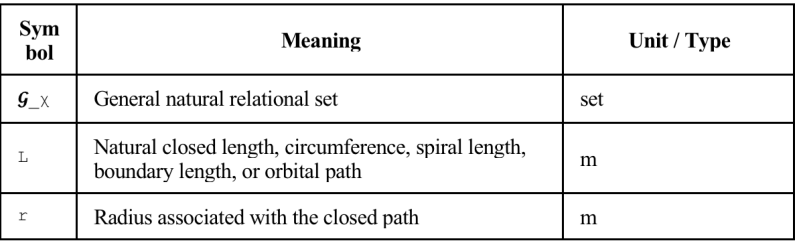
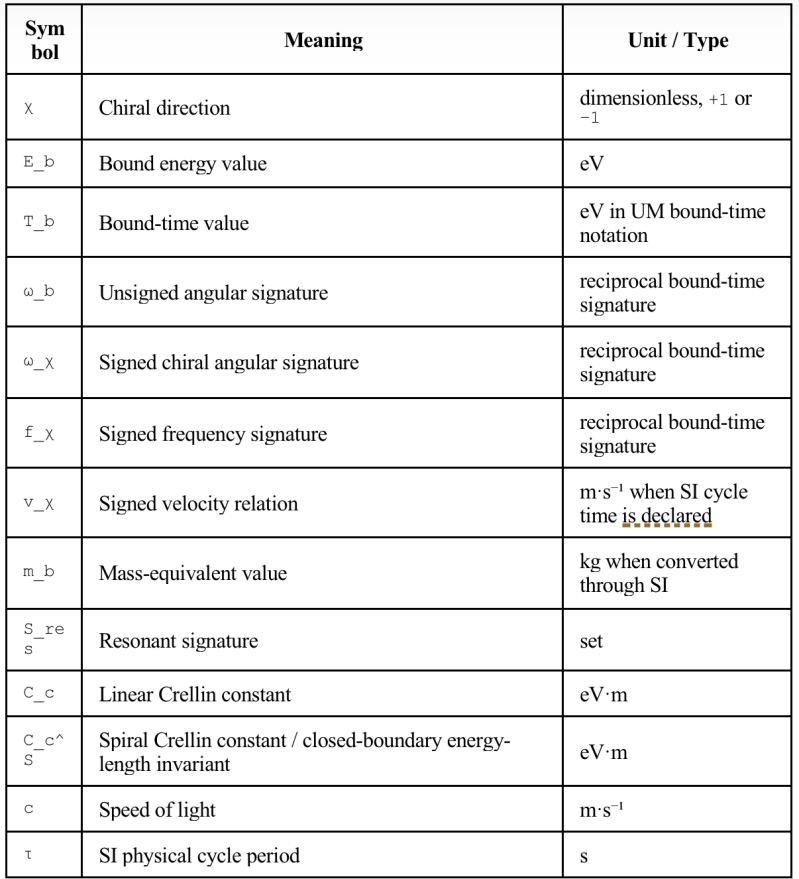
𝓖_χ = {L, χ, E_b, T_b, ω_χ, f_χ, v_χ, m_b, S_res}
where each member is connected by declared reaction rules.
This is not a single equation. It is a closed algebraic system.
3. Notations
4. Constants and Precision Values
4.1 Speed of Light
c = 299,792,458 m·s^-1
4.2 Reciprocal Light-Time Constant
T_c = 1 / c
T_c = 3.3356409519815205 × 10^-9 s·m^-1
4.3 Linear Crellin Constant
C_c = 0.0000012398419843320026223775274453 eV·m
Scientific form:
C_c = 1.2398419843320026223775274453 × 10^-6 eV·m
SI form:
C_c = 1.9864458571489286 × 10^-25 J·m
Use C_c for:
linear wavelength
open path
straight length
non-circumference length
4.4 Spiral Crellin Constant
C_c^S = 54.8498456441854475003664296231656952 eV·m
SI form:
C_c^S = 8.78811437814524 × 10^-18 J·m
Use C_c^S for:
closed boundary
circumference
spiral length
vortex loop
orbital path
cell membrane boundary
nuclear membrane boundary
planetary circumference
particle closed-loop state
resonant closed natural system
4.5 Universal Wrap Count
N = 44,239,384
Closure relation:
C_c^S / C_c = 44,239,384
4.6 Electron Linear Wavelength
λ_e = 2.426310238664879100783920290442866859 × 10^-12 m
4.7 Proton Wavelength Used
λ_p = 1.32140985539 × 10^-15 m
4.8 Electron-Volt Conversion
1 eV = 1.602176634 × 10^-19 J
5. Primitive Invariant
The Law of General Natural Relations begins with the closed energy-length invariant:
E_b L = C_c^S
This is the dimensional closure.
Because:
C_c^S = eV·m
then:
E_b L = eV·m
Therefore:
E_b = C_c^S / L
and:
L = C_c^S / E_b
This is the primary energy-length relation for natural closed systems.
6. Bound-Time Identity
The bound-time identity is:
T_b ≡ E_b
Meaning:
Bound Time Value = Bound Energy Value
In this paper, T_b is not ordinary SI clock time. It is the Universal Mechanics bound-time value, numerically identical to the bound mass-energy value.
The angular-frequency document states this directly:
Bound Time Value = Mass-Energy Value
and:
E_m = T_b
with angular frequency as the signature of that bound-time state.
angular freqency unification copy.docx
7. Angular Signature
Unsigned form:
ω_b = 2π / T_b
Signed chiral form:
ω_χ = χ(2π / T_b)
Because:
T_b ≡ E_b
then:
ω_χ = χ(2π / E_b)
Because:
E_b = C_c^S / L
then:
ω_χ = χ(2πL / C_c^S)
This is the integrated chiral angular-signature form.
Angular frequency is not the cause of the system. It is the signed signature of the bound-time state.
8. Frequency Signature
f_χ = ω_χ / 2π
Substitute:
f_χ = χ(1 / T_b)
Since:
T_b ≡ E_b
then:
f_χ = χ(1 / E_b)
Since:
E_b = C_c^S / L
then:
f_χ = χ(L / C_c^S)
Frequency is therefore not the energy driver. It is the signed reciprocal signature of the bound-time state.
9. Velocity Relation
For a radius-associated closed path:
v_χ = ω_χ r
Substitute:
v_χ = χ(2πr / T_b)
Since:
T_b = C_c^S / L
then:
v_χ = χ(2πrL / C_c^S)
For ordinary SI motion using a declared physical cycle time τ:
v = L / τ
and:
ω = 2π / τ
The paper must clearly distinguish:
UM bound-time angular signature
from:
SI measured angular velocity
unless a conversion or comparison path is explicitly declared.
10. Mass-Equivalent Value
Energy-to-mass conversion:
m_b = E_b / c^2
For SI kilograms, convert eV to joules first:
m_b[kg] = (E_b[eV] × 1.602176634 × 10^-19) / c^2
Since:
c = 299,792,458 m·s^-1
then:
c^2 = 89,875,517,873,681,764 m^2·s^-2
So:
m_b[kg] = (E_b[eV] × 1.602176634 × 10^-19) / 89,875,517,873,681,764
11. Complete Closure Set
The full closure set is:
𝓖_χ = {L, χ, E_b, T_b, ω_χ, f_χ, v_χ, m_b, S_res}
Expanded:
𝓖_χ =
{
L,
χ,
C_c^S / L,
C_c^S / L,
χ(2πL / C_c^S),
χ(L / C_c^S),
χ(2πrL / C_c^S),
(C_c^S / L) / c^2,
S_res
}
Compact operator form:
𝓖_χ(L, r) =
{
L,
χ,
E_b,
T_b,
ω_χ,
f_χ,
v_χ,
m_b,
S_res
}
with:
E_b L = C_c^S
T_b ≡ E_b
ω_χ = χ(2π / T_b)
f_χ = ω_χ / 2π
v_χ = ω_χ r
m_b = E_b / c^2
12. Full Reaction Rules
The Law of General Natural Relations must declare every valid reaction path. The algebra is only valid when the reaction path is explicit.
12.1 Length to Energy
L → E_b
E_b = C_c^S / L
12.2 Energy to Length
E_b → L
L = C_c^S / E_b
12.3 Energy to Bound Time
E_b → T_b
T_b ≡ E_b
12.4 Bound Time to Energy
T_b → E_b
E_b ≡ T_b
12.5 Bound Time to Angular Signature
T_b → ω_χ
ω_χ = χ(2π / T_b)
12.6 Angular Signature to Bound Time
ω_χ → T_b
Signed form:
T_b = χ(2π / ω_χ)
Magnitude-only recovery:
T_b = 2π / |ω_χ|
12.7 Energy to Angular Signature
E_b → ω_χ
ω_χ = χ(2π / E_b)
12.8 Length to Angular Signature
L → ω_χ
ω_χ = χ(2πL / C_c^S)
12.9 Angular Signature to Length
ω_χ → L
Magnitude form:
L = |ω_χ|C_c^S / 2π
Signed form:
L = χ(ω_χ C_c^S / 2π)
where L itself remains positive and χ carries direction.
12.10 Angular Signature to Frequency
ω_χ → f_χ
f_χ = ω_χ / 2π
12.11 Frequency to Angular Signature
f_χ → ω_χ
ω_χ = 2πf_χ
12.12 Bound Time to Frequency
T_b → f_χ
f_χ = χ(1 / T_b)
12.13 Frequency to Bound Time
f_χ → T_b
Magnitude form:
T_b = 1 / |f_χ|
Signed form:
T_b = χ / f_χ
12.14 Angular Signature and Radius to Velocity
ω_χ, r → v_χ
v_χ = ω_χ r
12.15 Velocity and Radius to Angular Signature
v_χ, r → ω_χ
ω_χ = v_χ / r
12.16 Radius to Circumference
r → L
L = 2πr
12.17 Circumference to Radius
L → r
r = L / 2π
12.18 Velocity and Cycle Period to Orbital Length
v, τ → L_orbit
L_orbit = vτ
12.19 Orbital Length and Cycle Period to Velocity
L_orbit, τ → v
v = L_orbit / τ
12.20 Orbital Radius to Orbital Length
R_orbit → L_orbit
L_orbit = 2πR_orbit
12.21 Orbital Length to Orbital Radius
L_orbit → R_orbit
R_orbit = L_orbit / 2π
12.22 Energy to Mass-Equivalent
E_b → m_b
m_b = E_b / c^2
SI form:
m_b[kg] = (E_b[eV] × 1.602176634 × 10^-19) / c^2
12.23 Mass-Equivalent to Energy
m_b → E_b
SI form:
E_b[J] = m_b c^2
eV form:
E_b[eV] = (m_b c^2) / 1.602176634 × 10^-19
13. Chiral Rules
13.1 Chiral Direction
χ = +1
one handed direction.
χ = -1
opposite handed direction.
The names of the directions must be declared in each audit. The algebra does not assume which physical handedness is called positive.
13.2 Chiral Angular Signature
ω_χ = χ(2π / T_b)
or:
ω_χ = χ(2π / E_b)
or:
ω_χ = χ(2πL / C_c^S)
13.3 Chiral Velocity
v_χ = χωr
or:
v_χ = ω_χ r
13.4 Chiral Inverse Pair
Two systems can share the same scalar values:
L_A = L_B
E_A = E_B
T_A = T_B
|ω_A| = |ω_B|
but differ by chirality:
χ_A = +1
χ_B = -1
Then:
ω_χ,A = -ω_χ,B
They are not the same resonant state. They are chiral inverses.
13.5 Chiral Match
χ_A = χ_B
This means same-direction resonance.
13.6 Chiral Opposition
χ_A = -χ_B
This means opposite-direction resonance.
This matters for:
cancellation
pairing
proton/electron opposition
spiral handedness
cell/nucleus angular relation
molecular antenna direction
orbital direction
resonant inversion
14. Ratio Laws
For two natural closed systems A and B using the same closed-boundary constant:
14.1 Energy Ratio
E_A / E_B = L_B / L_A
because:
E = C_c^S / L
14.2 Bound-Time Ratio
T_A / T_B = E_A / E_B
because:
T_b ≡ E_b
14.3 Angular-Signature Ratio
ω_A / ω_B = T_B / T_A
also:
ω_A / ω_B = E_B / E_A
also:
ω_A / ω_B = L_A / L_B
14.4 Reciprocal Lock
Magnitude form:
(E_A / E_B)(ω_A / ω_B) = 1
Chiral form:
(E_A / E_B)(ω_χ,A / ω_χ,B) = χ_A / χ_B
Same chirality:
χ_A / χ_B = +1
Opposite chirality:
χ_A / χ_B = -1
This means scalar equality is incomplete without chirality.
15. What the Law Computes
The Law of General Natural Relations can compute:
natural closed length
circumference
radius
orbital length
bound energy value
bound-time value
angular-frequency signature
frequency signature
signed chiral direction
signed velocity relation
mass-equivalent value
energy ratio
bound-time ratio
angular-frequency ratio
reciprocal lock
chiral match
chiral opposition
resonant signature
It can be applied to:
particles
atoms
molecules
cells
nuclei
microtubules
mitochondrial boundaries
planets
moons
orbits
spiral systems
closed natural resonators
The important point is that the object can be entered from different known values.
Known length can compute energy, bound time, angular signature, frequency, velocity, and mass-equivalent value.
Known energy can recover length, bound time, angular signature, and mass-equivalent value.
Known angular signature can recover bound time, energy, length, and frequency.
Known velocity and radius can recover angular signature and cycle relation.
Known orbital period and velocity can recover orbital length.
This is why the law is a closure algebra, not a single equation.
16. Worked Example: Generic Closed Boundary
Input:
L = 0.000062831853071795864769252867665590057684 m
χ = +1
C_c^S = 54.8498456441854475003664296231656952 eV·m
Energy:
E_b = C_c^S / L
E_b = 872,962.406209957816069417982526235457 eV
Bound time:
T_b = E_b
T_b = 872,962.406209957816069417982526235457 eV
Angular signature:
ω_χ = +(2π / T_b)
ω_χ = 0.00000719754397495601415724645117896766841738
Frequency signature:
f_χ = ω_χ / 2π
f_χ = 0.00000114556198426000523222767125844735588101
Resonant signature:
S_res = {L, χ, E_b, T_b, ω_χ, f_χ}
Expanded:
S_res =
{
0.000062831853071795864769252867665590057684 m,
+1,
872,962.406209957816069417982526235457 eV,
872,962.406209957816069417982526235457 eV,
0.00000719754397495601415724645117896766841738,
0.00000114556198426000523222767125844735588101
}
17. Biological Boundary Application
For a cell boundary:
L_cell = 2πr_cell
E_cell = C_c^S / L_cell
T_b,cell = E_cell
ω_cell = 2π / T_b,cell
For a nuclear boundary:
L_nucleus = 2πr_nucleus
E_nucleus = C_c^S / L_nucleus
T_b,nucleus = E_nucleus
ω_nucleus = 2π / T_b,nucleus
The static cell/nucleus energy ratio is:
D1 = E_nucleus / E_cell
Substitute:
D1 = (C_c^S / 2πr_nucleus) / (C_c^S / 2πr_cell)
Cancel:
D1 = r_cell / r_nucleus
The reciprocal angular-signature ratio is:
ω_nucleus / ω_cell = E_cell / E_nucleus
Therefore:
ω_nucleus / ω_cell = r_nucleus / r_cell
So if:
D1 = 5/3
then:
ω_nucleus / ω_cell = 3/5
This is a reciprocal biological boundary lock.
18. Planetary Application
For a planetary circumference:
L_planet = 2πR_planet
Closed-boundary value:
E_planet = C_c^S,scaled / L_planet
Bound-time value:
T_b,planet = E_planet
Angular signature:
ω_planet = 2π / T_b,planet
For observed spin using SI rotation period:
ω_observed = 2π / τ_rotation
Equatorial velocity:
v_observed = ω_observed R_planet
Planetary validation requires both sides to be declared:
NASA / observed datum
UM computed value
difference
percentage
ppm
ratio
The angular-frequency document developed this direction by building audit fields for planetary mass, radius, rotation period, angular frequency, velocity, scaled C_c^S, spiral value, bound-time value, difference, ppm, and ratio.
angular frequency unification copy.docx
19. Particle Application
For a particle closed-loop or spiral length:
L_particle = closed particle length
Energy:
E_particle = C_c^S / L_particle
Bound time:
T_b,particle = E_particle
Angular signature:
ω_particle = 2π / T_b,particle
For two particles A and B:
E_A / E_B = T_A / T_B
and:
ω_A / ω_B = E_B / E_A
The uploaded angular-frequency document applies this ratio logic to proton and neutron comparison, where greater bound mass-energy gives greater bound-time value and lower inverse angular signature.
angular freqency unification copy.docx
20. Validation Protocol
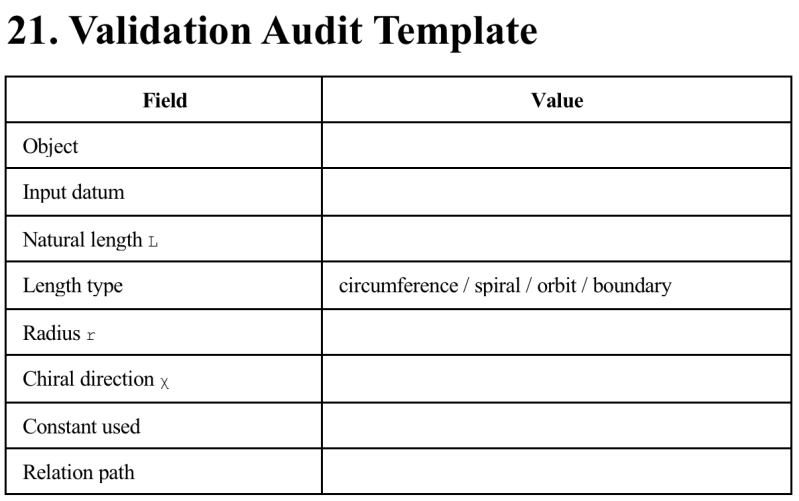
Every validation example must declare:
1. Object being tested
2. Natural length used
3. Whether L is circumference, spiral length, orbital length, or boundary length
4. Chiral convention
5. Constant used
6. Input value
7. Relation path
8. Output value
9. Known comparison value, if any
10. Difference
11. Percentage difference
12. ppm
13. Ratio
A valid audit must not mix input and output.
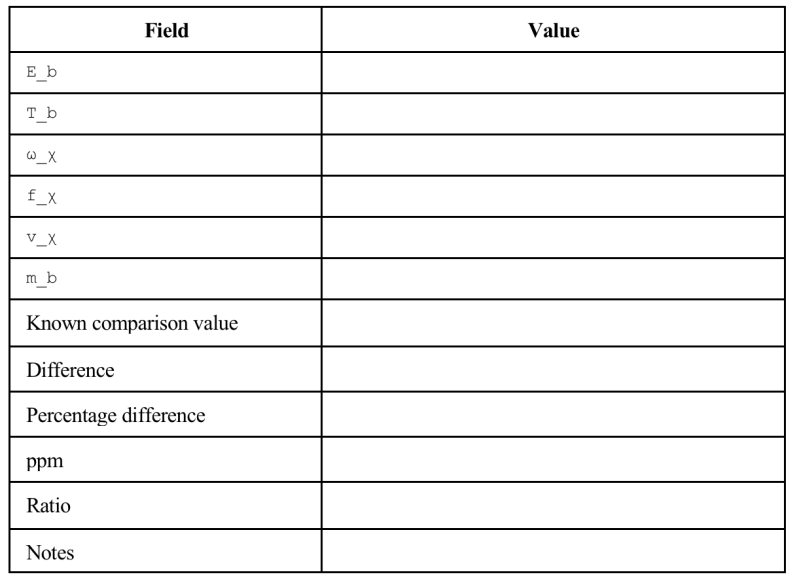
22. Falsification Protocol
The law is locally falsified if a declared relation path fails under independent calculation using:
stated input, stated constant, stated units, stated chirality convention, stated relation path.
A comparison is invalid if any of the following are missing:
input datum, constant used, unit system, chirality convention, relation path, scale factor, if used
known comparison value
A failed comparison must be classified as:
input error
unit error
relation-path error
scale-declaration error
true residual
A true residual must be reported as:
absolute difference
percentage difference
ppm
ratio
This makes the law reproducible and auditable.
23. Reproducibility Rule
A reader must be able to reproduce every result using only:
declared input value
declared constant
declared chirality
declared relation path
declared unit system
No hidden scaling is allowed.
No value may be moved from the output side to the input side without declaring it.
No comparison is valid unless the known comparison value is independent of the computed value.
24. Public Validation Strategy
The first validation release should lead with non-medical, reproducible systems:
Earth
Mercury
Moon
proton
electron
neutron
generic cell/nucleus boundary
microtubule circumference
Biology should be included as an application, but not as the lead claim.
The lead claim is mathematical:
Natural closed systems are closed relational sets.
The validation claim is:
Any declared member of the set can compute the others through the stated reaction rules.
25. Final Law Statement
The Law of General Natural Relations states that every natural closed system is a closed relational set. Its natural length, chirality, bound energy, bound time, angular signature, frequency signature, velocity relation, mass-equivalent value, orbital relation, and resonance are not isolated quantities. They are mutually recoverable through Universal Chiral Closure Algebra.
The primitive invariant is:
E_b L = C_c^S
The bound-time identity is:
T_b ≡ E_b
The signed angular signature is:
ω_χ = χ(2π / T_b)
Therefore natural closed length is an algebraic gateway into energy, bound time, angular signature, velocity, mass, orbit, and chirality.