Universal Mechanics
A first-principles framework for physics, built from causal mechanical derivation rather than abstraction or statistical interpretation.
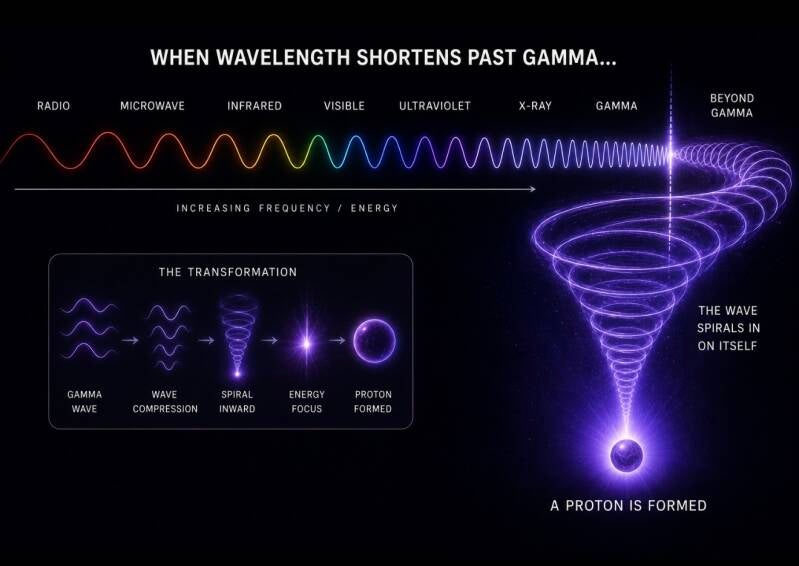
Universal Mechanics anchors every law and equation to the invariant speed of light, c, and to the energy-length invariance of the electromagnetic spectrum.
Explore the invariant laws
What Is Universal Mechanics?
Universal Mechanics is a first-principles framework by Lee Crellin that defines reality as a single, unified mechanical system governed by one underlying energy structure expressed through time, wavelength, geometry, spin, resonance, and motion.
At its foundation is a simple proposition: reality is not built from separate forces acting independently, but from one underlying energy system expressed through time, wavelength, geometry, spin, resonance, and motion.
Universal Mechanics replaces fragmented explanations with a unified structure. Light, matter, gravity, magnetism, redshift, chemical bonding, atomic structure, and biological resonance are treated as different expressions of the same underlying mechanical laws.
A central principle of Universal Mechanics is that mass generates time. Gravity is therefore not described as a mysterious attraction or as empty space bending without cause, but as the mechanical effect of mass-created time gradients. Matter creates a local time field, and motion follows the structure of that field.
The framework also introduces the Crellin Constant, (C_c), as a universal energy-wavelength anchor:
E\lambda = C_c
This relation links energy and wavelength directly, allowing physical systems to be examined through measurable transitions rather than abstract probability.
Universal Mechanics is deterministic. It does not rely on randomness, collapse, or probability as fundamental causes. Instead, it seeks to describe every stable system as the result of geometry, resonance, balance, and closure.
In this framework:
● Particles are structured energy systems.
● Atoms form through harmonic and geometric closure.
● Gravity arises from time generated by mass.
● Redshift is caused by light passing through mass-generated time fields, not by light losing energy.
● Chemistry is governed by resonance, angle, and temporal balance.
● Biology is a living expression of the same energy and field laws.
Universal Mechanics aims to restore science to a mechanical first-principles foundation: one energy, one structure, one connected set of laws.
It is not a collection of separate theories. It is a unified model of physical reality, built to show how the universe works as a single harmonic system.
Why is Universal mechanics different?
All constants and equations in Universal Mechanics are derived from two fixed invariants: the agreed invariant speed of light, (c), and the invariant energy–length relation of light across the electromagnetic spectrum.
Light always propagates at (c), while its energy and wavelength change in exact inverse relationship. Universal Mechanics treats this energy–wavelength product as the primary mechanical anchor of nature:
E\lambda = C_c
Where:
(E) = energy
(\lambda) = wavelength
(C_c) = the invariant energy–length constant of light
From this foundation, Universal Mechanics derives physical constants, field equations, particle structure, gravity, redshift, magnetism, chemistry, and resonance as different expressions of the same underlying light-based mechanical law.
In simple terms: the universe is built from invariant light-speed motion and invariant energy–length structure.
What Is Wrong With Current Science?
Current science is not wrong because its measurements are useless. It is wrong because its explanations are fragmented.
Modern physics has become divided into separate models: gravity, quantum mechanics, electromagnetism, particle physics, cosmology, chemistry, and biology are treated as different subjects with different rules, different constants, and different assumptions. The result is a science that can measure many things with great accuracy, but often cannot explain their common cause.
Universal Mechanics argues that the problem is not the data. The problem is interpretation.
Current science accepts the invariant speed of light, (c), but does not build all physical law from that invariant foundation. It accepts that light has an exact energy–wavelength relationship across the electromagnetic spectrum, but does not treat that relationship as the primary mechanical structure of reality.
Instead, science has built layers of separate theories around effects, rather than deriving those effects from one shared cause.
This has led to major unresolved problems:
- Gravity is described mathematically, but not mechanically explained from first principles.
- Quantum mechanics predicts outcomes, but replaces physical cause with probability.
- Dark matter and dark energy are introduced to support cosmological models rather than deriving gravity, redshift, and motion from a complete field mechanism.
- Particle physics classifies particles, but does not fully explain why their masses, ratios, wavelengths, and structures take the values they do.
- Chemistry describes bonding behaviour, but does not reduce bonding to a single universal resonance and geometry law.
- Biology is treated mainly as chemistry, rather than as structured electromagnetic resonance operating through living matter.
Universal Mechanics begins from a different position: nature should not require separate foundations for different scales.
If light, matter, gravity, magnetism, atoms, and biology all exist in the same universe, then they must ultimately obey the same underlying mechanical law.
The failure of current science is that it has become excellent at describing isolated effects, but poor at unifying cause.
Universal Mechanics restores the missing foundation by deriving constants and equations from two invariants: the invariant speed of light, (c), and the invariant energy–length structure of light across the electromagnetic spectrum:
E\lambda = C_c
From that foundation, Universal Mechanics treats the universe not as a collection of disconnected theories, but as one continuous system of energy, wavelength, time, geometry, resonance, and motion.
What Long-Standing Mysteries and Problems Does Universal Mechanics Resolve?
Current science is not wrong because its measurements are useless. It is wrong because its explanations are fragmented.
Modern physics has become divided into separate models: gravity, quantum mechanics, electromagnetism, particle physics, cosmology, chemistry, and biology are treated as different subjects with different rules, different constants, and different assumptions. The result is a science that can measure many things with great accuracy, but often cannot explain their common cause.
Universal Mechanics argues that the problem is not the data. The problem is interpretation.
Current science accepts the invariant speed of light, (c), but does not build all physical law from that invariant foundation. It accepts that light has an exact energy–wavelength relationship across the electromagnetic spectrum, but does not treat that relationship as the primary mechanical structure of reality.
Instead, science has built layers of separate theories around effects, rather than deriving those effects from one shared cause.
This has led to major unresolved problems:
● Gravity is described mathematically, but not mechanically explained from first principles.
● Quantum mechanics predicts outcomes, but replaces physical cause with probability.
● Dark matter and dark energy are introduced to support cosmological models rather than deriving gravity, redshift, and motion from a complete field mechanism.
● Particle physics classifies particles, but does not fully explain why their masses, ratios, wavelengths, and structures take the values they do.
● Chemistry describes bonding behaviour, but does not reduce bonding to a single universal resonance and geometry law.
● Biology is treated mainly as chemistry, rather than as structured electromagnetic resonance operating through living matter.
Universal Mechanics begins from a different position: nature should not require separate foundations for different scales.
If light, matter, gravity, magnetism, atoms, and biology all exist in the same universe, then they must ultimately obey the same underlying mechanical law.
The failure of current science is that it has become excellent at describing isolated effects, but poor at unifying cause.
Universal Mechanics restores the missing foundation by deriving constants and equations from two invariants: the invariant speed of light, (c), and the invariant energy–length structure of light across the electromagnetic spectrum:
[
E\lambda = C_c
]
From that foundation, Universal Mechanics treats the universe not as a collection of disconnected theories, but as one continuous system of energy, wavelength, time, geometry, resonance, and motion.